Share this infographic on your site!
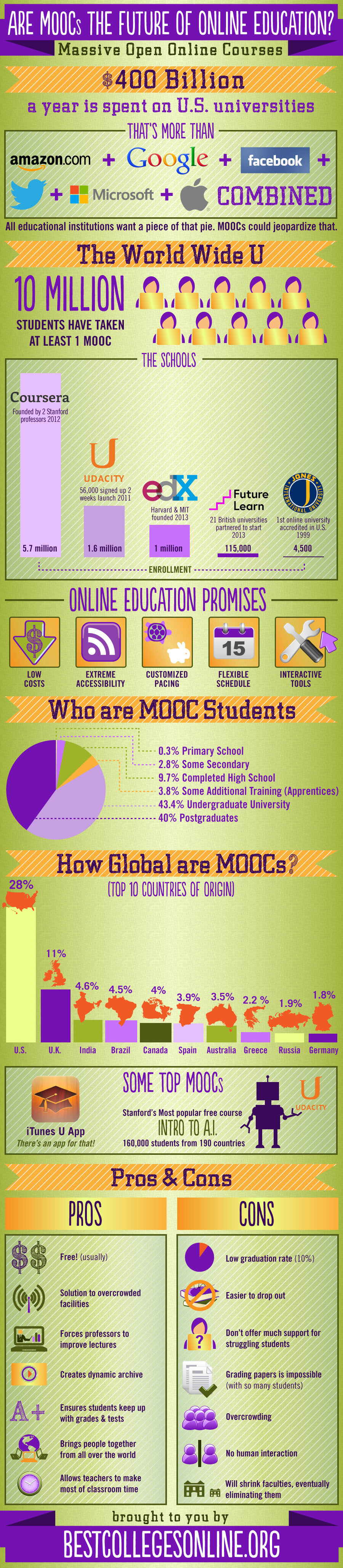
What's at stake?: $400 billion: amount of money spent annually in U.S. on universities The $400 billion represents: more than the annual revenues of Amazon, Apple, Facebook, Google, Microsoft, and Twitter combined.Every educational institution wants a piece of that pie. MOOCs could jeopardize that.
The World Wide U10 million: estimated number of students who have taken at least one MOOC
When it all began: The promise of online education:• low costs• extreme accessibility by anyone• customized pacing• flexibility in scheduling• more digitally based interactive tools
1985: Dave Cormier "coins" the term MOOC, for Massive Open Online Courses.
1993: Jones International University becomes first online U. [in the world]1999: JIU became first fully online university in the U.S. to be accredited.But it's not free: tuition is $12,7202013 enrollment (full and part time, undergrad and graduate): about 4,500
2012: Coursera founded by two Stanford professors5.7 million: most recent enrollment, Coursera83: number of universities and colleges around the world forming partnership with Coursera$65 million: amount of venture capital raised to fund Coursera
Udacity (2012)56,000: number of students who signed up for courses in Udacity two weeks after 2011 launch1.6 million students, to date
Edx:20: number of schools partnered in Edx, an online non-profit provider started by Harvard and MIT founded in 2013
FutureLearn:21: number of British universities partnered to start FutureLearn (2013)
Who are MOOC students? .3 % primary school2.8 % some secondary9.7% completed high school3.8% some additional training (apprentices)43.4 undergraduate university40.2 postgraduates
How global are MOOCs now (top 10 countries of origin): U.S.: 28%U.K. 11%India: 4.6%Brazil: 4.5%Canada: 4%Spain: 3.9%Australia: 3.5%Greece: 2.2 %Russia: 1.9%Germany: 1.8%
Top 10 MOOCs (free courses) • Udemy: Courses taught by teachers at Northwestern and Dartmouth (among others)• ITunesU – Apple's free app "gives students access to all the materials for courses in a single place. Right in the app, they can play video or audio lectures. Read books and view presentations."• Stanford• Most popular free course: Introduction to AI. 160,000 students from 190 countries..• UC Berkeley –Check out: Berkeley Webcasts and Berkeley RSS Feeds.• MIT Free Courses – Check out MIT's RSS MOOC feed. Also MIT's Open Courseware.• Duke Free Courses – Duke offers courses on ITunesU.• Harvard Free Courses –Get a free Harvard education. No application is required.• UCLA Free Courses –• Yale Free Courses –The school offers "free and open access to a selection of introductory courses taught by distinguished teachers and scholars at Yale University."• Carnegie Mellon Free Courses – Carnegie Mellon boasts "No instructors, no credits, no charge."
Pros and Cons of MOOCsPro• Free.• Provide a solution to overcrowding.• Force professors to improve lectures.• Create a dynamic archive.• Are designed to ensure that students keep up. MOOCS are real college courses, complete with tests and grades.• Bring people together from all over the world.• Allow teachers to make the most of classroom time in blended classes.• Offer interesting business opportunities. MOOC companies launched in 2012: edX by Harvard and MIT; Coursea, a Stanford company; and Udacity, which focuses on science and tech.Cons• Low graduation rate: estimated at about 10%• Easier for students to drop out• Do not offer much support for struggling students?• Interactivity, a challenge. [When you have…150,000 students]• Grading papers is impossible.• Overcrowding• Miss the magic of human interaction (in small groups)• Will shrink faculties, eventually eliminating them.
And now…. something new in 2013 (an alternative to MOOCs): SPOCs: Small Private Online Courses• New B-to-B concept: create an online course and license it to a university or an organization or corporation.• Colorado State Global Campus, first to offer SPOCs as an experiment• SPOCs have 17-25 students
- https://www.insidehighered.com/blogs/hack-higher-education/top-ed-tech-trends-2012-moocs
- https://www.elearnspace.org/Articles/MOOC_Final.pdf
- https://www.cdlponline.org/index.cfm?fuseaction=whatis&pg=3
- https://www.economist.com/news/business/21582001-army-new-online-courses-scaring-wits-out-traditional-universities-can-they
- https://nces.ed.gov/fastfacts/display.asp?id=98
- https://www.fool.com/investing/general/2013/11/19/online-educations-depressing-statistics-and-what-t.aspx
- https://www.fastcompany.com/3021473/udacity-sebastian-thrun-uphill-climb?partner=rss&utm_source=feedburner&utm_medium=feed&utm_campaign=Feed%3A+fastcompany%2Fheadlines+%28Fast+Company%29&curator=MediaREDEF
- https://www.bdpa-detroit.org/portal/index.php/comittees/high-school-computer-competition-hscc/29-education/57-moocs-top-10-sites-for-free-education-with-elite-universities.html
- https://adulted.about.com/od/Adult-Education-in-the-U.S./a/The-Pros-And-Cons-Of-Moocs.htm
- https://www.uk.idp.com/for_clients/aiec_2013_live/session_synopses_and_videos/moocs.aspx
- https://moocnewsandreviews.com/what-do-we-know-about-mooc-students-so-far/
- https://www.bloomberg.com/news/2012-04-18/education-startup-coursera-raises-16-million-from-kleiner-nea.html