Image source: www.rveduhenbcoprd.wpenginepowered.com
" alt="Crisis in Colleges: Where Are the Students?" width="500" border="0" />
Image source: www.rveduhenbcoprd.wpenginepowered.com " alt="Crisis in Colleges: Where Are the Students?" width="500" border="0" />
The editors at Best Colleges Online decided to research the topic of
Crisis in Colleges: Where Are the Students?
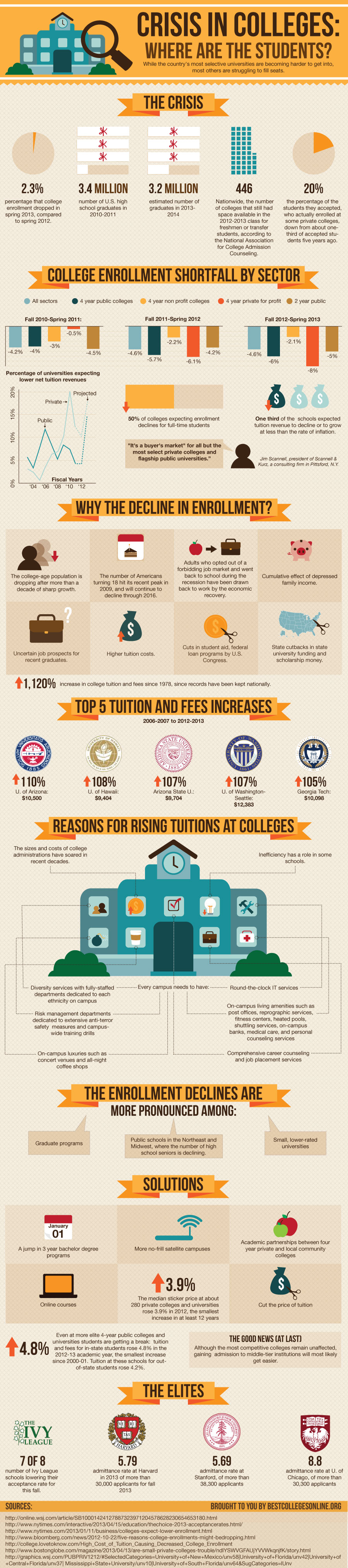
While the country's most selective universities are becoming harder to get into, most others are struggling to fill seats.
The Crisis:
- 2.3: percentage that college enrollment dropped in spring 2013, compared to spring 2012.– 3.4 million: number of U.S. high school graduates in 2010-2011– 3.2 million: estimated number of graduates in 2013-2014– 446: Nationwide, the number of colleges that still had space available in the 2012-2013 class for freshmen or transfer students, according to the National Association for College Admission Counseling.– 20: the percentage of the students they accepted, who actually enrolled at some private colleges, down from about one-third of accepted students five years ago.
College enrollment shortfall by sector:
- Fall 2010-Spring 2011:– All sectors: -4.2 percent– 4 year public colleges: -4 %– 4 year non profit colleges: -3%– 4 year private for profit: -.5 %– 2 year public: -4.5 %
Fall 2011-spring 2012
- All sectors: -4.6 percent– 4 year public colleges: -5.7%– Private for non profit: -2.2 %– 4 year private for profit: -6.1%– 2 year public: -4.2%
Fall 2012-spring 2013
- All sectors: -4.6 percent– 4 year public colleges: -6%– 4 year private for non profit: -2.1 %– 4 year private for profit: -8 %– 2 year public: -5 %– 50: percentage of colleges expecting enrollment declines for full-time students. A third of the schools expected tuition revenue to decline or to grow at less than the rate of inflation.– "It's a buyer's market" for all but the most select private colleges and flagship public universities.: Jim Scannell, president of Scannell & Kurz, a consulting firm in Pittsford, N.Y.
Why the decline in enrollment?
- 1. The college-age population is dropping after more than a decade of sharp growth– 2. The number of Americans turning 18 hit its recent peak in 2009, and will continue to decline through 2016– 3. Adults who opted out of a forbidding job market and went back to school during the recession have been drawn back to work by the economic recovery.– 4. Cumulative effect of depressed family income– 5. Uncertain job prospects for recent graduates– 6. Higher tuition costs– 7. Cuts in student aid, federal loan programs by U.S. Congress– 8. State cutbacks in state university funding and scholarship money– FACT: 1,120: the percentage increase in college tuition and fees since 1978, since records have been kept nationally.
Comparing: Top 5 tuition and fees increases 2006-2007 to 2012-2013
- 1. U. of Arizona, $10,500, a 110 % increase– 2. U. of Hawaii, $9404, 108 % inc.– 3. Arizona State U., $9704, 107 % inc.– 4. U. of Washington-Seattle, $12,383, 107 % inc.– 5. Georgia Tech, $10,098, 105 % inc.
Reasons for rising tuitions at colleges:
- 1. The sizes and costs of college administrations have soared in recent decades.– 2. Inefficiency has a role in some schools– 3. Every campus needs to have:– a. Round-the-clock IT services– b. On-campus luxuries such as concert venues and all-night coffee shops– c. Risk management departments dedicated to extensive anti-terror safety measures and campus-wide training drills– d. Diversity services with fully-staffed departments dedicated to each ethnicity on campus– e. On-campus living amenities such as post offices, reprographic services, fitness centers, heated pools, shuttling services, on-campus banks, medical care, and personal counseling services– f. Comprehensive career counseling and job placement services
The enrollment declines are more pronounced among:
- 1. Graduate programs– 2. Small, lower-rated universities– 3. Public schools in the Northeast and Midwest, where the number of high school seniors is declining.
Solutions:
- 1. A jump in 3 year bachelor degree programs– 2. More no-frill satellite campuses– 3. Online courses– 4. Academic partnerships between four year private and local community colleges– 5. Cut the price of tuition– 6. The median sticker price at about 280 private colleges and universities rose 3.9% in 2012, the smallest increase in at least 12 years– 7. Even at more elite 4-year public colleges and universities students are getting a break: tuition and fees for in-state students rose 4.8% in the 2012-13 academic year, the smallest increase since 2000-01. Tuition at these schools for out-of-state students rose 4.2%.– The Good News (AT LAST): Although the most competitive colleges remain unaffected, gaining admission to middle-tier institutions will most likely get easier.
The Elites
- 7 of 8: number of Ivy League schools lowering their acceptance rate for this fall.– 5.79: admittance rate at Harvard in 2013 of more than 30,000 applicants for fall 2013– 5.69: admittance rate at Stanford, of more than 38,300 applicants– 8.8: admittance rate at U. of Chicago, of more than 30,300 applicants
Sources
- http://online.wsj.com/article/SB10001424127887323971204578628230654653180.html– http://www.nytimes.com/interactive/2013/04/15/education/thechoice-2013-acceptance-rates.html/– http://www.nytimes.com/2013/01/11/business/colleges-expect-lower-enrollment.html– http://www.bloomberg.com/news/2012-10-22/five-reasons-college-enrollments-might-be-dropping.html– http://college.lovetoknow.com/High_Cost_of_Tuition_Causing_Decreased_College_Enrollment– http://www.bostonglobe.com/magazine/2013/04/13/are-small-private-colleges-trouble/ndlYSWVGFAUjYVVWkqnjfK/story.html